

Qingdao, China - October 2026 - Morland, a custom folding wagon manufacturer with 26 years of integrated sheet metal and plastics manufacturing experience, has completed production and shipment of its rear-opening folding wagon with integrated folding table board to a client in Turkey. The order was fulfilled through Morland's light customization program - frame color, fabric color, table board wood-grain pattern, and printed logo were all tailored to the client's brand, without the cost or lead time of a full ODM development cycle.
For B2B buyers, this order demonstrates a procurement path that sits between buying stock products and commissioning an entirely new one: meaningful brand differentiation at a fraction of the development investment.
What "Light Customization" Means - And Why It Matters
Not every buyer needs a ground-up product development program. Many brands, wholesalers, and e-commerce sellers need something more practical: a proven product that visibly carries their brand.
Morland's light customization program modifies an existing, production-validated wagon platform across four brand-visible dimensions, rather than re-engineering the product.
|
Stock / Wholesale |
Light Customization |
Full ODM Development |
|
|
Product platform |
Existing |
Existing |
New |
|
Visual differentiation |
None |
High (color, pattern, logo) |
Complete |
|
Tooling investment |
None |
None |
Required |
|
Typical MOQ |
100 pcs |
100–300 pcs |
Negotiated, higher |
|
Lead time |
15–25 days |
15–35 days |
3–12 months |
|
Development risk |
None |
Low |
Medium to high |
|
Best for |
Traders, price-led channels |
Brands entering or expanding a category |
Brands launching a unique product |
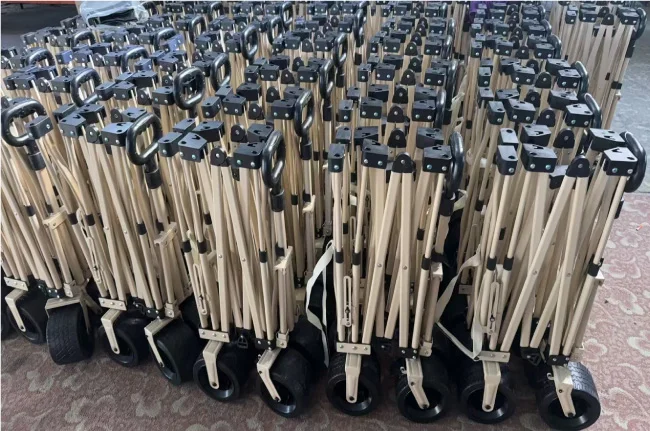
For a 200-unit order, light customization is usually the most rational choice: the client gets a wagon that looks like their own product on the shelf and in their marketing, without carrying tooling cost or an extended development timeline.
The Four Customization Elements in This Order
1. Frame Color
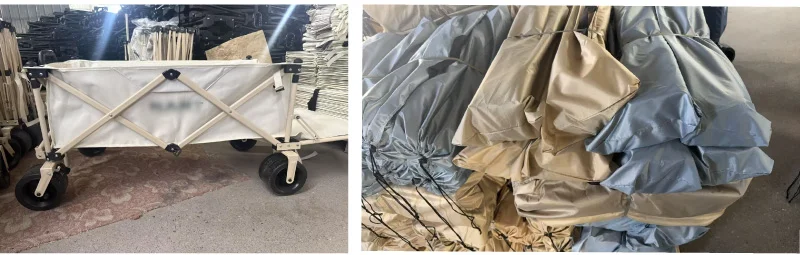
The steel frame is finished in the client's specified color, applied over Morland's standard corrosion-resistant pretreatment. Because Morland operates in-house metal fabrication and surface treatment, frame color can be matched to a RAL or Pantone reference rather than selected from a fixed palette.
Why it matters: Frame color is the most visible brand cue at a distance - in product photography, on a retail shelf, and in outdoor use.
2. Fabric Color
The wagon's fabric body is produced in the client's brand color. Morland's fabric sourcing covers standard outdoor-grade Oxford specifications, with color matching available to brand standards.
Why it matters: Fabric accounts for the largest visible surface area of the wagon, so it carries the most weight in brand recognition.
3. Table Board Wood-Grain Pattern
The folding table board is finished with a wood-grain pattern specified by the client. This turns a functional component into a design element - the table reads as a wood surface rather than a plain plastic or metal panel.
Why it matters: Wood-grain finishes position the product in a higher perceived price tier. For a wagon that doubles as a camp table, this is a low-cost upgrade with outsized visual return.
4. Printed Logo
The client's logo is printed on the wagon body at the specified position and size. Logo application is controlled during production rather than applied post-assembly, ensuring consistent placement across all 200 units.
Why it matters: Consistent logo placement across a full production run is what separates a branded product from a generic one with a sticker added later.
Product Focus: Rear-Opening Design with Folding Table Board
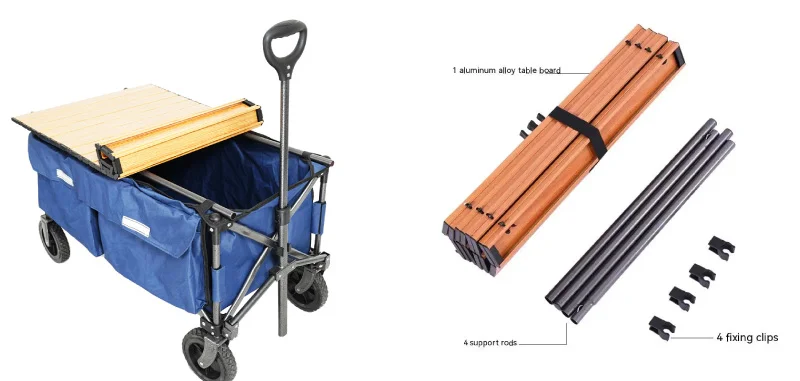
The wagon shipped in this order is built on Morland's rear-opening platform with an integrated folding table board.
Rear-opening design. The rear panel opens to allow loading through the back of the wagon body. This solves a real usability problem with standard enclosed wagons: long or bulky items - tent poles, folding chairs, firewood, coolers - can be loaded without lifting them over the side walls.
Folding table board. The table board provides a flat, stable work surface at camp - for food preparation, gear sorting, or as a serving area. Because it folds with the wagon, it adds function without adding a separate item to carry, pack, or ship.
Together, these two features move the wagon from "hauling tool" toward "camp furniture," which is a meaningful positioning upgrade for brands selling into the camping and overland categories.
Built on a Validated Platform: What That Means for Your Timeline
Because this order was built on an existing Morland model, the client avoided the three costs that typically burden a custom outdoor product program:
|
Cost avoided |
What it means in practice |
|
Tooling and mold investment |
No new mold development required - the wagon's frame, joints, and components already have production tooling |
|
Prototype iteration cycles |
Fit, folding mechanics, and load behavior were already validated in production |
|
Extended qualification timeline |
Existing platforms already carry Morland's ISO9001 quality management and ISO14001 environmental management controls |
The practical result: a customized, branded wagon delivered on a standard production lead time rather than a multi-month development schedule.
FAQ
Q: What is the minimum order quantity for a custom folding wagon?
A: Morland's standard MOQ is 100 pieces for custom folding wagon orders. Light customization orders such as this 200-unit shipment to Turkey fall within standard production scheduling.
Q: What can be customized on an existing folding wagon model?
A: Frame color, fabric color and specification, table board finish and pattern, printed logo and placement, wheel type, packaging, and carton printing. Structural changes to the frame or folding mechanism require full ODM development.
Q: How long does a light customization order take?
A: Standard bulk production lead time is 15–35 days. Light customization orders involving color matching, pattern development, and logo setup typically run slightly longer, depending on approval cycles.
Q: Do I need to pay for mold or tooling for a custom folding wagon?
A: Not for light customization. Because the product is built on an existing platform with production tooling already in place, there is no new mold investment. Tooling cost applies only to full ODM programs requiring new components or structures.
Q: Can Morland ship folding wagons to Turkey and Europe?
A: Yes. Morland exports to markets across Europe, the Middle East, North America, and Asia, and handles export packaging, container loading, and documentation for sea freight.
Q: What certifications does Morland hold?
A: Morland operates under ISO9001 quality management and ISO14001 environmental management certifications.
About Morland
Morland is the outdoor products brand of Qingdao Time Outdoor Products Co., Ltd, a manufacturer with 26 years of experience in sheet metal fabrication and plastic injection molding. The company designs and manufactures high-end folding wagons, rooftop tents, wheelbarrows, storage boxes, outdoor furniture, and pet strollers for global B2B clients.
With in-house mold development, injection molding, and sheet metal stamping, Morland provides integrated custom manufacturing solutions - from component design through production, assembly, quality control, and shipping.
B2B Services: OEM/ODM support · MOQ from 100 pcs · 15–25 day lead time · Custom colors, patterns, logos, and packaging
Ready to Build Your Own Wagon Program?
If you are evaluating a custom folding wagon program - whether a 200-unit branded run like this one or a full ODM development - send us your requirements. We will confirm what can be customized on an existing platform, what requires new tooling, and what your realistic timeline and landed cost look like.
Browse Folding Wagons · Request a Customization Consultation
You May Also Like
Folding Camping Wagons: A Sourcing Guide for Brands and Retailers Cooperation Case:American All-in-One Lawn Chariot Folding Wagon


