

A repeat custom folding wagon build is where a manufacturer's engineering response gets tested, not its catalogue. Between the previous generation and this V3 two-row wagon, market feedback reached production as changed tube geometry, a capped coating thickness and new carton dimensions - all inside delivery window.
A Repeat Build Is the Real Test of Customization
A first order tests a factory's ability to develop a product. A repeat order tests its ability to change one without breaking production, and those are different competencies with different failure modes.
The customer is a US outdoor brand selling through national retail channels, and this build is not its first order with Morland. Successive repeat orders have moved the product through several generations, which changes the nature of the work: instead of proving a design can be built, the manufacturer has to prove a shipped design can be improved without disrupting supply. Development failures show up as missed samples; repeat-build failures show up as mixed configurations, late cartons, and parts that no longer fit after a cosmetic change.
The distinction matters to a brand owner because the second-order problem is invisible in a sample room. Consumer feedback arrives months after launch - a wheel that loads unevenly in summer heat, a carton that loses shape in a stacked container, a brand mark that reads poorly on a cast surface. Translating that feedback into a production change requires three things at once: a mold or fixture that can be altered, an engineering route that is faster than scrapping tooling, and a build sequence that absorbs the change without resetting the schedule.
Morland has operated sheet metal stamping and injection molding in-house for 26 years, and tooling is developed in-house. Owning both sides of the process is what makes a mid-program change practical.
What Field Feedback Changed in the V3 Build
|
Item raised from the field |
Requirement it addresses |
|
Front frame tube position two tubes moved outward in per side |
Steering linkage spacing and wheel verticality |
|
Powder coating thickness |
Assembly clearance; excess film makes the joint seize or refuse to close |
|
Packaging protection |
Arrival condition after ocean freight |
|
Carton specification |
Case count and stacked-container fit |
|
Cast aluminum brand mark |
Whether the logo is carried on the casting |
|
Wheel assembly under heat load |
Carry behaviour at elevated temperature |
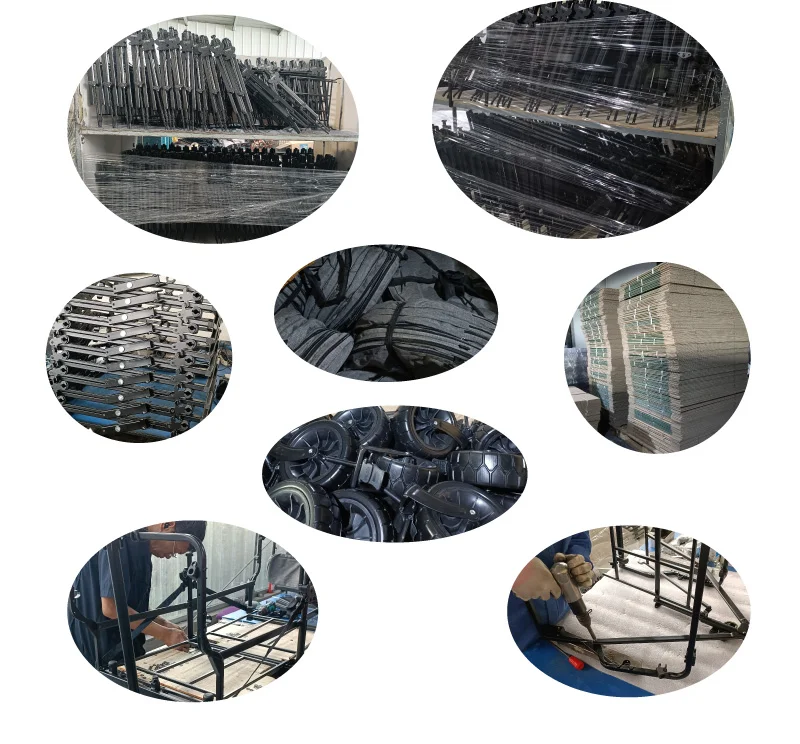
The frame tube change looks smallest and costs most to get wrong. Linkage spacing and wheel verticality move together: correct one without the other and the wagon pulls. The route taken was a welding fixture rework at the machining centre.
Coating thickness is an assembly parameter wearing a cosmetic job title. Powder builds on the surface, so two mating parts each gaining 0.15 mm per side consume 0.30 mm of the clearance the design had. Above that the joint needs force, and force on a coated joint damages the film.
Packaging changes target arrival condition rather than factory condition. Foam decouples the frame from the carton wall so a side impact travels into the corrugated structure instead of into the tube, and resetting carton dimensions to the folded envelope reduces internal movement. Carton specs also drives landed cost and loading quantity.
FAQ
Q: How long does a repeat custom folding wagon order take?
A: Standard bulk orders run 25-45 days; a fully custom wagon with fixture changes and new carton geometry needs the longer window.
Q: Do you build brand new design folding wagons with our logo?
A: Yes. Like this program is a two-row seating wagon with customer-specified structure, fabric and canopy. Vehicle type, frame structure, fabric specification and canopy are all developed to the customer's design rather than selected from a fixed catalogue.
Q: What is your MOQ for a custom folding wagon?
A: MOQ is 100 pcs for standard custom orders, deep custom MOQ 1000, depending on container loading.
About Morland
Morland is the outdoor products brand of Qingdao Time Outdoor Products Co., Ltd, operating in Qingdao, China with 26 years of sheet metal fabrication and plastic injection molding experience. Folding wagons, rooftop tents, wheelbarrows, storage boxes, outdoor furniture and pet strollers are developed and manufactured in-house, with mold development, stamping and injection molding under one group.
Custom folding wagon programs run OEM and ODM, with MOQ from 100 pcs and standard bulk lead time of 25–45 days. Certifications: ISO 9001 and ISO 14001.
Looking for a factory with manufacturing capabilities to produce folding carts and outdoor gear that match your brand identity?


